Modernising the clinical waste disposal infrastructure
Case Studies
Ecuador: Private Approach To Medical Waste Disposal
Medical waste disposal has become a multi-million-pound global industry. Alongside government bodies and aid agencies, the private sector has established itself to bridge the gaps wherever they may appear.
In this instance, Aquakleaner S.A, based in Ecuador, is already a successful waste disposal operation specialising primarily in wastewater, sewage, septic tanks and grease traps. After working with several municipalities, they initially planned to build their own water treatment plant for domestic and industrial water. This plan eventually evolved once they discovered a need for sustainable medical waste disposal in Ecuador due to a lack of accessible medical incinerators.


Recognising the opportunity to establish and operate a privately managed clinical waste disposal site as well as the financial and environmental benefits that this will bring. Aquakleaner selected one of their existing sites in the coastal region of Manta to convert to become their first medical disposal site.
Having chosen their location and begun work on redeveloping the site to be suitable for the change of use into a waste disposal site, they set about researching exactly what machine would be able to meet all of the requirements and, most importantly, who they could trust to supply it. Following intense research, the owner of the family-run business contacted us to begin the journey.
C200 Medical Incinerators For The Punjab
Back in 2017/18, our team delivered a record number of MP medical incinerators across Punjab Pakistan to support hospitals and health centres across the province. In 2023, following years of successful operation and expansion the government of the Punjab in collaboration with our long-term business partner for Pakistan, Vertex Medical once more returned to us to review their best options for two new facilities.
Continuing population growth has led to a desperate need for more healthcare facilities. These have in turn led to an increase in the need for sustainable solutions for disposing of hazardous medical and pharmaceutical waste created daily across the province’s hospitals and clinics in many instances in remote and inaccessible locations.
The Punjab is the second largest province in Pakistan and covers an area one and a half times that of England, its population of 127,688,922 is more than double England’s 55,000,000.
As such even with the previous installations in 2018 we still had an awful lot of work to do with Vertex Medical to ensure that the prior barriers to sustainable disposal of medical waste continued to be remedied.

Before our previous installation of 25+ medical incinerators in 2018 the province, much like many rapidly developing countries, was faced with a common problem when disposing of so much waste daily. With the support of Vertex and the commitment of the government, we were able to overcome it.
For this new project, we wanted to ensure that the following issues were not able to return and hinder the success of the waste disposal initiative.
Beginning with a basic lack of infrastructure all health centres and hospitals, especially in more rural areas, need a reliable system to either transport waste to a central facility or manage it on-site. When this is not present, unfortunately, waste could often be discarded on local grounds or end up being burnt in firepits or outdated equipment.
The installation of these 2 C200 high throughput medical incinerators opens up a range of possibilities not just able to safely dispose of all waste created onsite, but they are large enough to be able to also dispose of medical waste from local health centres and clinics ensuring no more waste ends up being a hazard to the community.
Awareness is vital for new installations to succeed operatives and local healthcare workers need to understand the benefits of the new incinerator and the risks with the old methods. As part of every installation, we ensure training is delivered and the results are always compared to previous methods where the cleanliness of our results speaks for themselves turning operatives into advocates.
Self Contained Solutions To Medical Waste For The Nigerian Navy


In 2021, following 18 months of international turmoil, 4 containerised MP500 medical incinerators were commissioned at Hospitals and Health Centres across Nigeria. To safely, effectively and thoroughly manage healthcare waste.
Ordered mid-2020, just as the impact of the Coronavirus caused most of the world to go into lockdown. These four Addfield MP500 machines were purchased by the Nigerian Navy to provide a reliable source of waste disposal to the thousands of people being treated daily across the hospitals, clinics and medical centres located across the coastal regions of Nigeria.
By November 2020, the four facilities were completed before being independently inspected by Bureau Veritas and then collected, beginning their journeys to Nigeria. Built in Addfield’s factory in Great Britain, SONCAP certification was obtained for export to Nigeria with the support of the UK’s Department Of International Trade.


The implementation of these advanced incinerators has been developed for ease of use and longevity, able to be loaded and deashed comfortably alongside being clear to access for servicing and maintenance to ensure that they are able to be kept in the best operational condition for decades to come.
Delivered across coastal regions of Nigeria, the final destinations for these machines were
Naval Medical Centre BORIKIRI, based at Port Harcourt
Nigerian Navy Reference Hospital, CALABAR
Nigerian Navy Hospital, OJO, LAGOS
Nigeria Navy Hospital, WARRI
Selecting the containerised options provided the added benefits of a fully self-sufficient ready-to-go hazardous waste treatment facility. Each container included the MP500 incinerator alongside a securely double-bunded fuel tank and generator in a securely sectioned-off area. The containers were fitted with full-length access doors and side-opening doors, providing full access to the entire system, ideal for loading and long-term maintenance. These waste management solutions are rapid to install and commission requiring minimal groundworks and facilities to establish.


Containerised solutions provide a high-quality factory finish to an installation. They are undoubtedly one of the most effective solutions to provide fast relief to the problem of hazardous waste.
For the installation, Abraham Bah travelled out to be met by our local engineer Emmanuel Eikhenomian before meeting with a representative from the Navy and travelling to all four sites to complete the installations, commission the machines and to train local operators on how to get the best out of each machine, achieving maximum results whilst providing general maintenance and how to complete an annual service. Before leaving, our team provided access to the full online training to ensure that they are able to manage the servicing of the machines independently.
The machines were originally purchased to manage the mixed medical waste created in the general operation of a number of hospitals and medical centres. The largest of our MP range, these are the perfect solution for hospitals with around 500 beds in use at a time.
Although self-contained these incinerators have been installed in several semi-permanent structures which, if required, can be quickly dismantled to allow the incinerators to be rapidly moved to areas of high demand.
These installations have provided an invaluable addition to the well-being of the communities surrounding these health centres, as prior to their installation, the hazardous waste that was generated was previously disposed of via unreliable general waste collection, which was not the ideal way to prevent the risks of cross-contamination, an element of medical waste that has never been as valued as since the arrival of the Coronavirus pandemic.
During the two-week installation, Abraham and Emmanuel were welcomed by many members of the community, including many senior naval officers, including the DMS Commander, who had great enthusiasm for the successful installations.
The impact that these machines will make on the region was visible during the installation, and being able to see them in operation first-hand really brought the value of the option for containerised incinerators as an essential option for many customers.

Modernising Sudan’s the clinical waste disposal infrastructure
The infrastructure of Sudan is considered underdeveloped, and with the added challenges following a prolonged civil war, logistics can be extensive. Non-Governmental Organisations (NGOs) like the WHO face many obstacles carrying out their work in country, as it does for Addfield when it comes to installing these critical medical waste disposal incinerators.
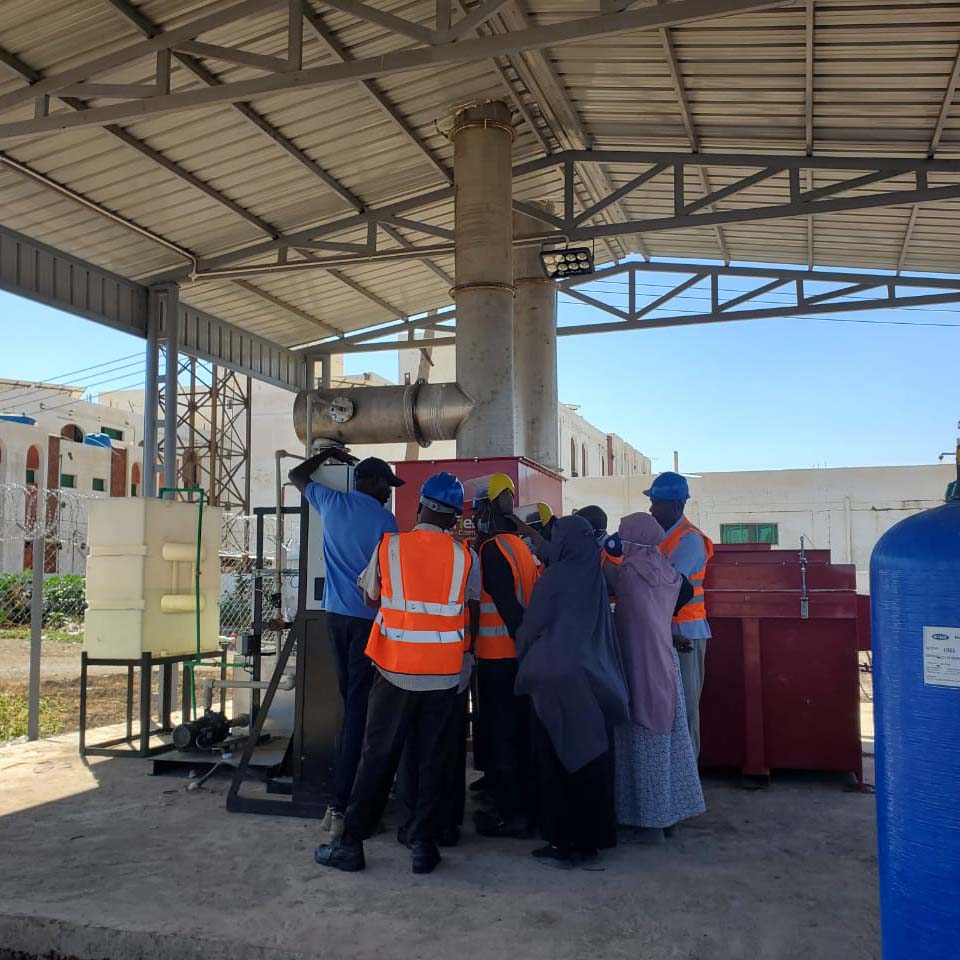
Manufacturing started at our factory in Staffordshire, UK where the machines underwent rigorous testing by our Technical Engineer, Jinto as part of our Factory Acceptance Testing. To provide additional securities to the local environment the GM750s were supplied with a modified variant of the venturi scrubber, specifically designed to reduce emissions that may occur during the combustion process, using a reagent dosing system.
The incinerators operate at a very high temperature to destroy pathogens from the hazardous and contaminated medical waste and other materials that are being disposed of. This added filtration system ensures that harmful gases aren’t going to be released into the environment, making them more environmentally friendly.


The Challenges in Sudan
This could have been a very challenging installation for us due to the ongoing instability across the region were it not for the support of our expert international engineers that are located near Sudan. Each of these essential the medical incinerators were installed at Hospitals and Health Centres across the country, with logistical support from the WHO.
To ensure a long and successful disposal of hazardous waste will be achieved as part of the installation process our engineers delivered a full range of face-to-face training to the local operators, covering optimal usage, ongoing maintenance and servicing of the incinerators. As of today, the machines have been handed over to the Ministry of Health, and the installation of the equipment has been widely recognised as a success.
It is a particularly crucial time in Sudan, with the country reacting to multiple outbreaks of diseases and the current conflict, the installation of the eight GM750s is another support beam in the efforts of strengthening the healthcare in Sudan and one that we are proud to have been a part of.


MP100 Medical incinerator for Vaccination Disposal in North Africa
In many circumstances, people often consider that medical waste is generated as a by-product of illness or injury. One area that is often overlooked is the disposal of medicines and more importantly products leftover from immunisation and vaccination programs.
We recently supported a leading international aid agency in the supply of one of MP100 (Medical Pathological) incinerators. The project was to provide reliable and safe disposal of medical waste for a clinic that delivered a high ratio of immunisation and vaccinations against multiple diseases.
As this waste would comprise of a higher than standard ratio of used needles and glass vials we needed to review our options to ensure that we would deliver them the best solutions.
We recommended our MP range which is very popular in health centres, clinics and hospitals across North Africa and Asia. Partly due to the fact that they are front loading which means they can be loaded and reloaded throughout the incineration process. This enables the waste to be disposed of as it is generated, rather than having to be left around waiting for the next cycle.
Being front loading also makes the de-ashing process more efficient and ergonomic to use. Due to the nature of the wastes having a higher than average amount of metal and glass following incineration. These now sterile materials can easily be processed and segmented prior to recycling.


Following the incineration process, any packaging and general medical waste will be reduced to inert ash whilst any glass vials and sharps will be sterilised and safe to dispose of using more traditional methods either crushing, landfill or recycling depending upon the final waste management systems in place.
The MP100 was selected to provide this service, due to the popularity of the of the MP range which has proven itself to be highly reliable and effective for multiple aid agencies worldwide. Often installed in remote and inhospitable environments whilst ensuring a consistently high quality level of disposal.
Due to it’s scale it was able to be installed in an onsite building removing the additional complications of safely transporting the waste offsite due to it’s hazardous composition.
As with all of our installations we ensure that full training was provided onsite to guarantee that the workforce was fully capable of operating the machine in an optimal manner. As well as passing over the skills and knowledge to complete essential servicing and maintenance tasks as required without having to rely on bringing our engineers back every year.
Overall it has been a highly successful operation with the incinerator delivering results that have exceeded our customers’ expectations leading to further orders of our MP machines for multiple locations and requirements.

HIV Research Programme in Africa
Supporting the Medical Research Council in Africa
Several state of the art medical waste incinerators have been installed across Africa in Uganda and the Gambia. Installed on behalf of the Medical Research Council to support the work carried out to monitor and control the HIV outbreaks and support the actions in place to reduce its spread.
Founded in 1913 the MRC has a long history of working to develop science to deliver life-changing improvement to health systems within the UK and across the globe and have since become a part of the government-funded UK Research and Innovation programme. They approached Addfield following a period of market research investigating the safest options available to them.
Prior to our involvement, the HIV waste was disposed of using two outdated approaches to incineration that would turn the waste into a tarball after incineration. However due to the increasing age of these machines operation was limited, requiring the doors to be open during an operation meant that they could only be operated at night as they were highly polluting.
Halting the spread across the nation
At the date of installation, it was estimated that over 26 million sub-Saharan citizens were infected with HIV and as part of the Millennium Development Goals program was the control and prevention of this disease. As part of this strategy, an infrastructure was required to ensure these targets are achievable. Part of this infrastructure would be the inclusion of Addfield Medical Pathological (MP) incinerators.
Which incinerator was the right choice?
For medical waste incineration including viral testing it is essential to guarantee a complete burn is possible. Through the inclusion of a ‘hot hearth’ which allows the waste to be heated from below removing any cold spots for a more complete incineration the MP machines are second to none. Purposefully designed for the secure incineration of red and yellow bag biohazardous waste such as discarded medicine, sharps, human anatomical, soiled, and microbiology waste. The front loading design is not only for ease of use but also ensures there is a lack of restriction to where the incinerator can be located making them extremely easy to operate and maintain. Ideal for remote installations. In this instance 3 of MP100 machines were selected.
Now installed our customers have given us great feedback about the operation, and benefits that the advanced design has given them able to operate any time rather than being restricted to only night time operation as per the old approaches.

Waste Management in Algeria
Client Overview
Stidest specialises in the collection, treatment and incineration of waste. Their main groups are pharmaceutical, veterinary, medical and paramedical. This usually consists of expired drugs, waste with a risk of infection and general medical waste you would expect to find at a hospital.
Stidest’s main asset was their incinerators, but the ones they had from an Addfield competitor were unfit for purpose. So much so that they were later taken off the company’s website and ceased selling the machine.
An incinerator is needed
As Algeria’s leading waste management company, they needed machines that were able to cope with the large capacity of waste that would be incinerated each day which averages 500 yellow bags (clinical waste) and 200 red bags (biomedical waste). Addfield suggested our one of our larger incinerators, the TB-AB-MAX, for the general medical waste and the MP-500 for high moisture biomedical waste.

The importance of Incineration
Incineration is a vital way of disposing of medical waste due to the following:
Infection can easily be spread between animals and humans if the waste is not disposed of appropriately.
Medical waste can be highly toxic, so contact with it should be as limited as possible.
Injuries often occur in countries where it is the norm to forage through waste for potential valuables.
Medical waste often contains chemicals that can be harmful to the environment when accumulated.
Advantages of using Addfield Incinerators
Addfield provided a range of scrubbers which are used with the machine to further reduce emissions from the incinerator, making it exceptionally environmentally friendly.
Unrivalled experience that has been nurtured through hands-on experiences, such as commissioning machines on site.
All Addfield ranges are specifically designed for their intended use to ensure that the highest efficiency is gained for the waste type.
Which incinerator
The TB-AB-MAX has a huge capacity of 4000kg and an equally remarkable burn rate of 250kg to 500kg per hour, depending on the calorific nature of the waste. This is controlled by our unique air control system and an intelligent PLC controller that can independently modulate individual burners, ensuring a stable and controlled burn process.
The MP-500 is specifically designed for high moisture and/or low calorific waste such as human organs, blood and swabs – a traditionally hard-to-burn waste group. Hot hearth technology utilises a twin burner system for the complete oxidation of waste. It operates by a hearth (or underfloor) burner superheating the silicon carbide tiles on which the waste sites.
